
Two businesses can sell nearly identical products in the same market at the same price, but only one business feels trusted, established, and a good choice. The other, even with a good product mostly overlooked.
The difference is not usually the product. It is how the business is visually perceived before any interaction takes place.
Customers form instant judgments based on branding consistency, design quality, and overall brand visual identity. These judgments happen in seconds, long before reading a description or comparing features.
Research shows that 67% of consumers believe that it is a lack of consistent branding that affects a company’s credibility and 90% link consistent branding with professionalism. This is why graphic design for small businesses is no longer optional. It directly shapes whether a business grows into recognition or fades into invisibility.
To understand this clearly, we need to look at how visual systems separate growing businesses from those that get ignored.
The Real Divide Between Growth and Invisibility
The difference is not effort or product quality; it is visual structure.
Growing businesses are built on clarity:
- A consistent color system across all platforms
- Unified typography and spacing rules
- A recognizable Brand visual identity
- Clean, intentional packaging and communication
- A repeatable visual system, customers quickly learn
Ignored businesses lack structure:
- Multiple design styles used across platforms
- No defined visual identity system
- Inconsistent typography and colors
- Disconnected packaging, website, and social media
- No single visual pattern for memory to attach to
This matters because consumers do not recognize a brand through color alone. When consistency is missing, recognition never forms, and without recognition, attention cannot be sustained.
How Perception Is Formed Before Experience
Before customers evaluate a product, they evaluate how it appears.
This is not a conscious decision, but it is a psychological shortcut. The brain processes visual signals to determine whether or not it can trust what it sees.
Studies show:
- 67% of consumers question credibility when branding is inconsistent
- 90% associate consistency with professionalism
- 81% say trust influences repeat purchase decisions
These numbers reveal an important pattern: trust is not built after experience; it is triggered before it.
A strong Brand visual identity signals order, reliability, and stability. A weak or inconsistent identity signals uncertainty, even when the product itself is strong.
This is where many businesses unknowingly lose attention before they even enter consideration. Effective branding for small businesses fosters good first impressions and encourages customers to explore more.
Why Most Businesses Become Invisible
Invisibility is rarely a marketing problem. It is usually a visual clarity problem.
1. Lack of consistency destroys recognition
When every platform looks different, customers cannot store a stable memory of the brand. Each interaction feels disconnected from the last.
2. Excess visual noise reduces attention
Competing fonts and messages make it difficult for any single idea to stand out. The result is confusion rather than clarity.
3. Outdated visuals weaken perceived value
Even strong products lose credibility when the design feels old or neglected. Visual presentation often sets expectations for quality.
4. Weak presentation reduces decision confidence
Customers frequently evaluate appearance before they evaluate performance. If the first impression feels unclear, they move on.
This becomes especially visible in retail environments where attention is limited, and decisions happen in seconds. A strong example of this is Hip Chick Farms, where customers liked the product itself. But the packaging failed to stand out on the shelf. Once the visual system and packaging design were improved, the brand saw 300% sales growth, followed by an additional 30-40% increase after further refinement.
This is an example of how small business branding isn’t just about looking pretty. A company’s visual identity is important to gain attention even before customers start considering the product itself.
What Growing Businesses Understand About Visual Identity
Growth does not come from isolated design improvements; it comes from repetition done correctly.
Successful businesses build systems where every visual element reinforces the same identity:
- The same colors appear everywhere
- Typography remains consistent across all platforms
- Packaging aligns with digital branding
- Social media follows a unified visual language
- Every touchpoint strengthens memory
Over time, this repetition builds familiarity. Familiarity reduces friction. Reduced friction leads to faster trust.
Why does brand recognition help businesses is not just a branding question, it is a growth question. Recognition removes uncertainty, and certainty drives action.
Turning Visibility Into Strategy
Businesses that move from ignored to recognized don’t rely on bigger budgets; they rely on clearer systems.
The most effective improvements usually start with:
- Defining a clear visual identity system
- Applying brand consistency across all platforms
- Removing design contradictions across touchpoints
- Simplifying communication for faster recognition
- Prioritizing clarity over creative complexity
This is where graphic design for small businesses becomes strategic rather than decorative. Design is no longer about appearance, but it becomes a system for decision influence.
Building Stronger Brand Systems with the Right Support
Many businesses understand what needs to change, but struggle to execute it consistently across platforms. This is where structured branding support becomes valuable.
Platforms like Comright help businesses create cohesive visual identities that align design and brand consistency across all touchpoints. Instead of fragmented visuals, businesses gain structured systems that improve recognition and trust over time.
When a brand looks unified everywhere, it becomes easier for customers to remember and easier to choose.
Clarity Matters More Than Visibility in Business Growth
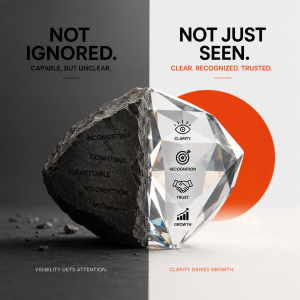
The difference between a growing business and one that gets ignored is not luck, but it is visual clarity. A strong visual identity makes it easy for brands to be recognized and remembered. Businesses that get ignored usually lack this clarity, not capability.
The brand needs to shift from designing for appearance to designing for recognition. Clarity builds familiarity that helps to drive trust and action.
If your business is struggling to stand out, the issue may not be your product but your visual system. Explore how Comright can help you build a structured, consistent identity that turns clarity into real business growth.